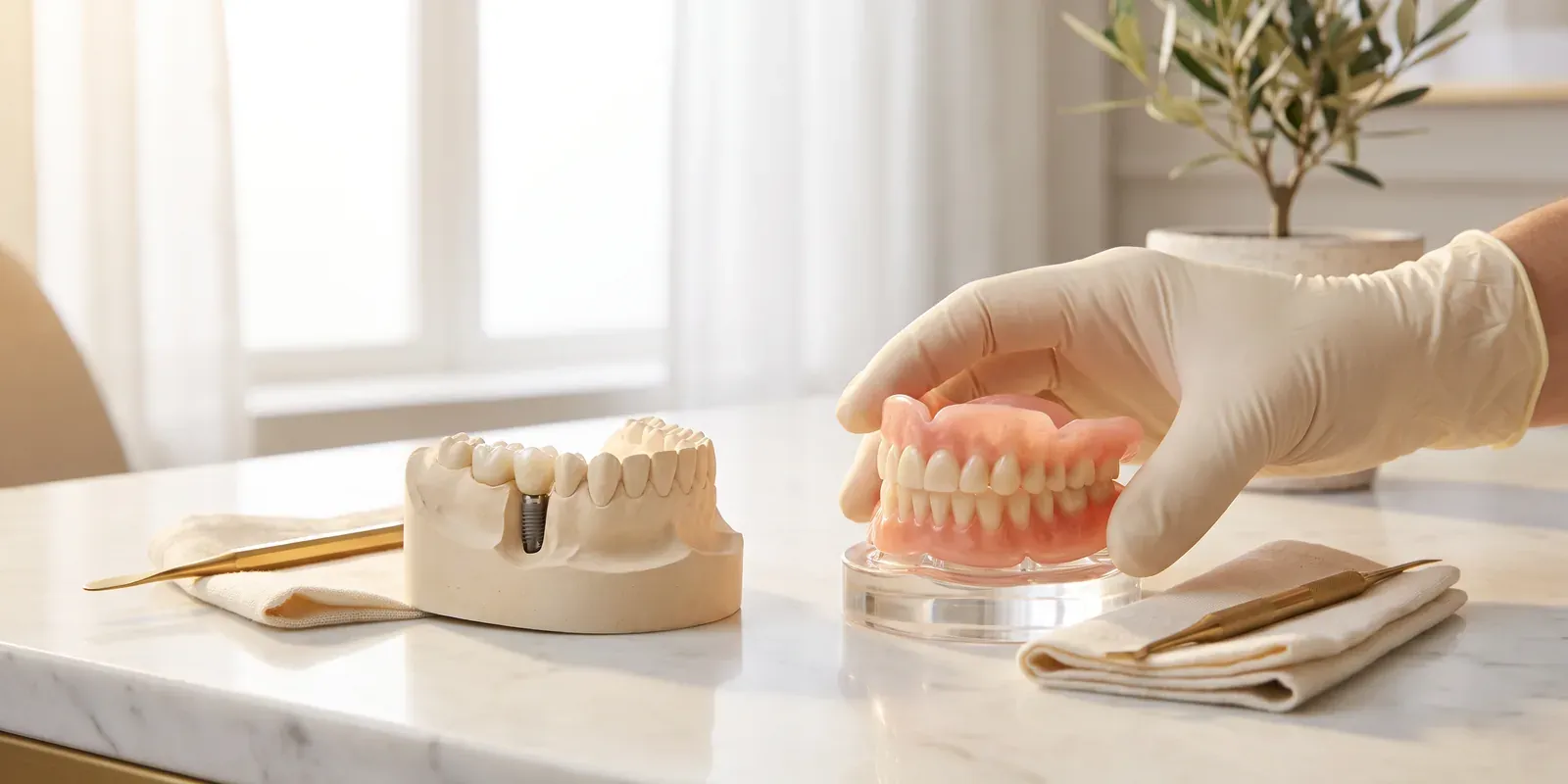
Whether it impairs your ability to eat the foods you like or damages your confidence in your smile, a missing tooth is a nuisance that can negatively affect your overall oral health. Luckily, there are several modern solutions to the age-old problem of tooth loss. Dentures and dental implants are two of the most popular.
At our office, we know that dental implants can offer a comfortable, reliable, long-lasting solution to missing teeth. But what exactly are they, and how are they different from dentures? Today, we’ll be comparing the two by answering the most common questions about both.
How Are They Secured?
Dentures must be secured to the gums using a special adhesive or paste. Even with adhesive, dentures (especially ill-fitting or old dentures) can slip around or fall out of your mouth while eating, speaking, yawning, or laughing. This can be embarrassing, painful, and inconvenient.
Dental implants are surgically placed into the jawbone, rooting them in place, and topped with a dental crown. The jawbone will “grow” around the implant in an osseointegration process, creating a naturally-integrated long-lasting replacement for the missing tooth.
How Often Do They Need to Be Removed?
Dentures must be removed regularly for cleaning and to relieve your gums and adjacent teeth from the pressure of supporting the dentures.
Except in rare cases where an implant needs to be adjusted or replaced, dental implants never have to be removed. They are a long-lasting solution for your missing teeth. However, removable prosthetics are an option if a patient would like to remove their dental implants at will.
How Often Do They Need to Be Adjusted?
Dentures require periodic adjustments to ensure their continued fit and function.
Except in very rare cases, dental implants never have to be adjusted. They stay in place securely and function like your natural teeth.
How Many Teeth Can Be Replaced?
Both dentures and implants can be made to replace individual teeth, bridges of teeth, or a full set of teeth.
Several adjacent teeth can be replaced using one dental implant. You do not need one dental implant per every missing tooth, which means you can enjoy full mouth dental implants without requiring 32 separate implants.
How Are They Cleaned?
Dentures must be removed regularly to be soaked, rinsed, and cleaned using the special denture cleaning solution.
Dental implant crowns are cleaned just like your natural teeth. Brush and floss them every day to keep them shining and support healthy gums and adjacent teeth.
What Are They Made Of?
Neither modern dentures nor the tooth crowns on dental implants is made from real teeth. Instead, they are a synthetic structure usually crafted from porcelain or acrylic resin.
Do They Look and Feel Natural?
Though dentures can sometimes look and feel quite natural, they are prone to slipping around and coming out. They can also place abnormal pressure onto the gums and adjacent teeth, causing discomfort.
Dental implants can restore the look and feel of your natural teeth. Individual results vary. Because they are rooted directly into your jaw, they do not place pressure on your gums or real teeth, and they are not designed to come out (unless you want them to).
How Do They Affect Chewing Capacity?
You are much more limited in your food options with dentures than with your natural teeth. Hard foods like apples, corn on the cob, chewy candies, and caramel must be avoided, as they can displace or damage the dentures and create pressure on the gums.
On the other hand, dental implants can restore much of your natural chewing capacity. Individual results vary. So go ahead, tear into that corn on the cob! Your teeth aren’t going anywhere.
To Where Do They Transmit Force?
The biomechanical forces of chewing and grinding are transmitted to your gums and the surrounding teeth with dentures. This can be both painful and damaging to your overall oral health.
Like your natural teeth, dental implants transmit force directly into your jawbone. A good dental surgeon will carefully assess the proper angulation and size for a well-placed dental implant. In some cases, your surgeon may recommend extractions or bone grafts before placing the implant to ensure your jawbone’s continued strength and stability.
Do They Prevent Bone Loss in the Jaw?
The jawbone often shrinks after tooth removal, damaging the integrity of the facial structure and weakening the bone. Dentures cannot combat this.
Dental implants, however, synthetically replace the missing root of the tooth and stimulate the jawbone, helping prevent bone loss and preserving the integrity of your facial structure. Individual results vary.
How Long Do They Last?
There is no such thing as “lifelong dentures.” Dentures typically need to be replaced over time.
Dental implants are designed to be a long-lasting replacement for missing teeth when they are well cared for. Individual results vary.
How Much Will They Cost?
Costs vary, but dentures are lower-priced up-front than dental implants on average.
However, dentures have additional cleaning, maintenance, and more frequent replacement costs. Dental implants are a long-term investment.
If you have questions about whether dental implants are right for you, we can help. Dr. Kerri Hill at The Art of Dental Wellness has more than 25 years of experience restoring healthy smiles, and we offer procedures for full-mouth dental implants, teeth bridge dental implants, and individual tooth implants. No matter your tooth replacement needs, we can work with you to restore your teeth’s health, function, and look. Contact us to request your appointment.
The questions patients ask us first
How are dentures and dental implants secured?
Dentures are held to the gums with adhesive or paste and can slip while you eat or speak. Dental implants are surgically placed into the jawbone and topped with a dental crown.
How do you clean dental implants compared with dentures?
Dentures are removed regularly to be soaked, rinsed, and cleaned with a denture solution. Implant crowns are cleaned like natural teeth, with daily brushing and flossing.
Do dental implants help with jawbone loss?
Yes. Implants replace the missing tooth root and stimulate the jawbone, which helps prevent bone loss. Dentures cannot combat bone loss.
Do I need one implant for every missing tooth?
No. Several adjacent teeth can be replaced using one implant, so a full set of teeth does not require 32 separate implants.
This article is general information, not personal medical advice. Every smile and treatment plan is different, so Dr. Hill reviews your options with you at your consultation.